

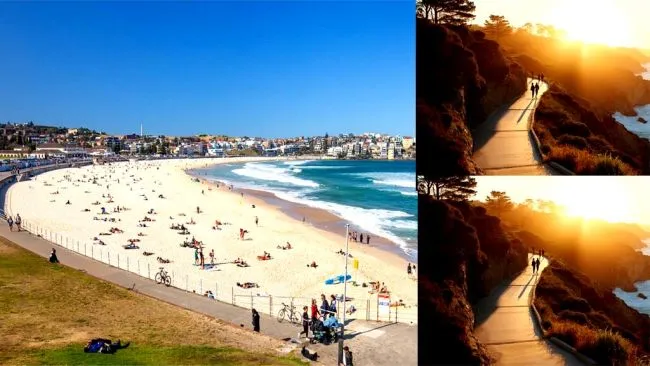
On a card-perfect afterlife autumn, the kind that has cemented
Bondi Beach in the global imagination as a sun- drenched paradise, the unbelievable unfolded. The gentle meter of the Pacific, the horselaugh from cafes, and the distant thump of a weekend playlist were shattered not by a guileful surge, but by a terror of mortal origin.
In a nippy, horrifying sequence, the iconic oceanfront of Sydney’s most notorious sand came a scene of profound tragedy, marking it not with vestiges, but with unforgettable loss. Ten lives, different in story and pledge, were violently silenced, leaving a nation in shock and a community scuffling with a grief that felt as vast as the ocean before it.
The Arc of a Daymare Six twinkles That Changed Everything
The timeline is brief, a horrifying contraction of chaos. Just after 320 PM on a bustling Saturday, a single existent, armed with a cutter, began an attack within the Westfield Bondi Junction shopping centre, a mecca of everyday life conterminous to the sand’s route. For roughly six twinkles, he moved through the complex.
The response was both immediate and heroic. Ordinary shoppers came first askers, using bollards and chairpersons to try to intermediate. Within moments, the first police officers were on the scene. Their battle with the bushwhacker, performing in his death, ended
The immediate trouble but could n’t undo the desolation formerly wrought.
In those transitory, frenzied twinkles, a macrocosm of eventuality was extinguished. The victims were n’t statistics; they were individualities whose Bondi lives were intricately woven into the fabric of the megacity a youthful developer browsing for a birthday gift, a security guard fulfilling his duty, a new mama , an transnational pupil, a loving father.
They were the people who make up the crowd in the iconic Bondi print — the very picture of vibrant, smart Australian life.
The terrain of Grief A Sanctuary Violated
To understand the depth of this trauma, one must understand Bondi’s place in the Australian psyche. It’s further than a sand; it’s a temporal tabernacle of heartiness, community, and egalitarian rest. Its golden bow is a popular space where millionaires and alpinists partake the same beach, where the ritual of the ocean syncope is a form of contemplation, and where the weekend growers’ request is a social sacrament.
Readmore A Flicker in the Dark: An Afghan IOC Member’s Quiet Gambit
The attack did n’t do on the beach
But in the marketable heart that services its life. This violation of a” third place” the essential social surroundings separate from home and work is profoundly destabilizing. Bondi Junction’s Westfield was n’t just a boardwalk; it was the community’s living room, its closet, its meeting ground.
To have it converted into a killing field strikes at the core of collaborative trust. The shockwaves have gurgled from the centre’s polished bottoms to the oceanfront itself, casting a pall over a place synonymous with debonair joy.
Biographies in Loss The Faces Behind the Number
The true weight of the tragedy is carried in the individual stories, each a world lost
Faraz Tahir, a 30- time-old security guard, recently arrived from Pakistan, who was on his first shift at the centre. He was celebrated as a” idol” who lost his life in the line of duty, a man seeking a new morning in Australia.
Ashlee Good, a 38- time-old osteopath and new mama , Bondi who desperately passed her nine- month-old baby to nonnatives in an act of unconceivable love and survival instinct. The baby, injured but surviving, came a symbol of both heartbreaking loss and miraculous adaptability.
Jade Young, a 47- time-old mastermind and mama of two,
An integral part of the Bondi community. Pikria Darchia, a 55- time-old artist and developer, flashed back for her vibrant creativity. Bondi Dawn Singleton, 25, the son of a prominent businessman, flashed back as a” kind- hearted” woman with a bright future in fashion.
Yuan Chen, a Chinese transnational pupil.
The individualises of others are a memorial of the attack’s arbitrary, encompassing atrocity.
These are n’t victims; they’re people. A developer, a protection, a healer, a mama , a pupil, a son. Their collaborative absence leaves a jagged gash in the social fabric.
The deconstruction of Response Heroism in the Face of Horror
In the vacuum of those six twinkles, humanity did n’t retreat; it advanced. The heroism that surfaced was raw, immediate, and devoid of form.
The” Bollard Man” and Fellow Civilians French construction worker Damien Guerot and others, with no study for their own safety, picked up whatever was at hand — bollards, chairpersons to defy the bushwhacker, directly abstracting him and likely saving lives.

This spontaneous, collaborative courage defined the original response.
The Solo Police Inspector The womanish police officer who entered the centre alone, engaged the bushwhacker, and eventually annulled the trouble with a single shot, executed a split-alternate decision with professional perfection under unconceivable pressure. Her conduct halted the holocaust.
The First Askers and Medical Staff
Paramedics, police, and latterly, sanitarium brigades worked under violent stress to treat the injured, their training booting the chaos.
This response forms a pivotal, redemptivecounter-narrative to the horror. It underscores that indeed in the face of designed chaos, the abecedarian Australian instinct for” mateship” a clicked, practical solidarity — remains a important force.
The Long Oceanfront of Mourning A Community and Nation Grieve
The mourning has been public, but it’s locally, at Bondi, where the grief is most tactile. New monuments of flowers piled at the centre’s entrance and along the sand boardwalk have come Bondi spots of passage.
The ocean, generally a source of remedy, now seems a silent substantiation. Community lookouts have drawn thousands, their participated silence louder than any roar of the suds.
Readmore A Sudden Silence in the Rubble: The Devastating Tale
This collaborative mourning is a necessary public ritual.
In a society frequently indicted of digital disaffection, people have felt a primitive need to gather physically, to partake space, gashes, and silence, to affirm that the community, though wounded, remains.
The positive Questions and the Path Forward
In the fate, the ineluctable, agonizing questions arise Why? Could this have been averted? The bushwhacker, known to police with a history of internal health challenges, yet not on any terror watchlist, represents a familiar and complex profile in ultramodern mass violence — an individual falling through the cracks of multiple systems.
