

Ashes in the City of Canals: A Historic Church Burns on a ‘Defiant’ Amsterdam New Year
Amsterdam, the City of conduits, ate a new time beneath its customary cover of downtime pall and celebratory light.
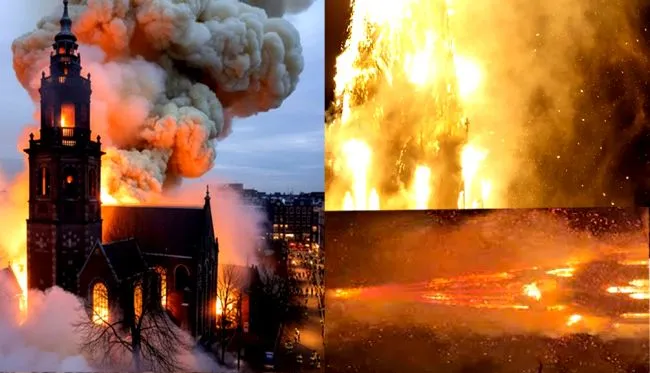
But as 2023 faded into memory, a different, more primitive light erupted in the heart of the major De Pijp quarter. dears, ferocious and uncontainable, clawed at the night sky, consuming the iconic De Krijtberg — aneo-Gothic unqualified church that had stood as a spiritual and architectural lamp for nearly a century and a half.
What began as a night of fireworks, music, and hopeful toasts was suddenly, violently, converted into a night of horror, loss, and profound collaborative grief. This was n’t just a fire; it was a cremation of history on a night meant for revitalization, leaving behind ashes in a megacity famed for its adaptability.
The imagery was severely paradoxical the joyful explosions of New Year’s .
fireworks mingling with the destructive roar of a corner in its death fray. The blaze, reported shortly after the night chimes, defied the sweats of over a hundred firefighters who battled for hours in the nipping night.
Their gallant struggle was n’t just against fire, but against time, graveness, and the heartbreaking drugs of collapse.
By dawn, where a majestic becket formerly pierced the Amsterdam skyline, there remained only a smoldering shell of blackened gravestone, a peering crack in the megacity’s major fabric.
The” recalcitrant” spirit of a New Year a time to look forward with resolution — was now indelibly scarred by an act of disastrous loss, forcing a look backward at what can noway be replaced.
further Than Stone and Stained Glass The Soul of De Krijtberg
To understand the depth of the loss, one must understand what De Krijtberg represented. Consecrated in 1883, it was further than a church church; it was a monument to a specific moment Ashes of unqualified reanimation in the generally Protestant Netherlands.
Its French- inspiredneo-Gothic armature, with its intricate façade, soaring becket, and famously ornate interior — a stark discrepancy to Calvinist austerity — made it a statement of faith and identity.
Within its walls abided not just pews and an balcony, but a macrocosm of impalpable heritage
Acoustics of the Soul The church was famed for its exceptional acoustics and its major Michaëliskoor( St. Michael’s Choir), one of the Netherlands’ oldest. The music that reverberated within its gravestone vaults was a living thread to centuries of sacred tradition.
A Sanctuary of Art It Ashes housed significant religious artworks, statuary, and liturgical objects — each a piece of spiritual art history.
A Community Anchor For generations of Amsterdammers.
particularly the megacity’s unqualified community, it was a place of investment, marriage, solace, and festivity — a constant in the ever- changing civic geography.
Its destruction is thus a triadic loss architectural, Ashes artistic, and spiritual. It’s the erasure of a physical masterpiece and the silencing of a specific, reverberative voice in Amsterdam’s different chorus of history.
The” recalcitrant” Paradox festivity Amidst Catastrophe
The fire’s timing on New Year’s Eve layers the tragedy with a cruel irony. This is a night the Dutch celebrate with particular vigor, known for its massive, Ashes decentralized, and frequently chaotic public fireworks displays. The expression” recalcitrant New Year” captures the public spirit of conviviality that persists despite sanctioned restrictions and safety warnings.
In this environment, the fire at De Krijtberg forces a delicate, necessary public discussion.
While the cause remains under critical disquisition by authorities, the immediate association with wide amateur fireworks is necessary for a Ashes traumatized public. The incident becomes a horrifyingly pictorial symbol in the long- running debate between artistic tradition and public safety.
Can a nation’s” recalcitrant” festivity be conformed with the protection of its irreplaceable heritage and the safety of its citizens and exigency services? The ashes of De Krijtberg now energy this debate with a new, woeful urgency.
The mortal Response Grief, Solidarity, and a craving for Answers
In the cold light of New Year’s Day, the community’s response began to take shape. Hundreds gathered behind safety walls, not to celebrate, but to mourn in astounded silence .
Social media swamped with photos —” before” shots of the magnific innards juxtaposed with the terrible, real- time images of its destruction. The collaborative Ashes grief was palpable, transcending religious cooperation; this was felt as a loss for all of Amsterdam.
Readmore From Rhyme to Reason: How Nepal’s Rapper-Turned
Social Media
Architectural chroniclers and preservationists spoke of an” irrecoverable crack” to the megacity’s 19th- century cover. The church clerk and community leaders gave tearful interviews, expressing shock but also a flexible faith, covenanting to rebuild. This immediate pivot from grief to a pledge of reconstruction is itself a form of defiance .
A turndown to let the story end in ashes.
Yet, alongside solidarity, there’s a stewing public demand for responsibility and clarity. The disquisition will need to answer painful questions Was this a terrible accident, a slapdash firework, or commodity differently? Could it have been averted? What does this mean for unborn fests near major, vulnerable structures?
A Broader Reflection Vulnerable Heritage in an Urban World
The burning of De Krijtberg is n’t an insulated incident. From Notre- Dame de Paris to Glasgow’s School of Art, the world has watched in recent times as major milestones have been destroyed by fire. Each event is a stark memorial of the profound vulnerability of our participated artistic heritage.
These structures, frequently centuries old, were constructed before ultramodern fire canons.
Their rustic roofs, open innards, and growing electrical systems make them terrifyingly susceptible.
The De Krijtberg fire amplifies a critical, global discussion about heritage threat mitigation the need for advanced fire discovery systems, acclimatized repression results, and comprehensive disaster preparedness plans for every significant major structure.
It raises the question of whether our traditional ways of celebrating, of living, are compatible with the stewardship of these fragile monuments.
