

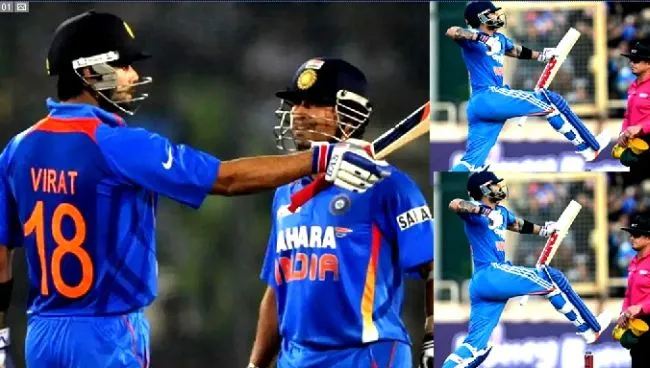
After the God: How Virat Kohli Built a New Cricket Pantheon in Sachin Tendulkar’s Shadow
In the world of Indian justice, ages are defined by the divinitieswho command the crinkle. For nearly a quarter of a century, the pantheon had a single, undisputed autonomous Sachin Tendulkar.
His heritage was n’t just statistical; it was spiritual.
He was” The God of Cricket,” a figure who carried the expedients of a billion, his club a sacred instrument that soothed public anxieties and penned cooperative joy. When he ultimately walked into the evening in 2013, he left behind a silence so profound it felt like a vacuum.
Who could conceivably follow a god?
The answer was a fiercely talented, tempestuous youthful man from Delhi who did n’t seek to be a deity, but commodity maybe indeed more poignant for his generation a revolutionary.
This is the story of how Virat Kohli, Cricket standing exactly in Sachin’s monumental shadow, did n’t simply succeed him, but erected an entirely new justice pantheon in his own recalcitrant, demanding, and dominant image.
The Inherited Burden The Weight of the Sacred Jersey
Stepping into the Indian platoon while Tendulkar was still playing was one thing; getting the heir at law to his throne was another. Kohli did n’t inherit a platoon; he inherited a public religion. The challenge was empirical How does one sculpt a heritage when every innings is measured against a sacred,pre-existing textbook?
Kohli’s original approach was n’t reproduction.
But intensification. Where Sachin was a composed, technically pristine monument, the youthful Kohli was a unpredictable force of nature. His aggression was n’t just a style of play; it was a statement of intent.
He wore his passion on his sleeve Cricket— celebrating with furious roars, defying opponents, and playing with a fire that was originally seen as brash, indeed iconoclastic, to the addicts of Sachin’s serene focus. This was his first masterstroke he refused to be a pale dupe.
Pillar I The Redefinition of Chase- Mastery( The New Dharma of Pursuit)
still, Kohli came the personification of the successful conclusion, If Tendulkar was the adulatory experience of an innings. He penned a new Cricket Book the philosophy of the run- chase. While Sachin’s genius lay in constructing monumental innings, frequently while setting a target, Kohli’s hand came the cold wave, calculated analysis of one.
His record in successful ODI run- chases is the stuff of ultramodern legend — comprising over 65, with an astonishing number of centuries. He did n’t just chase targets; he possessed the fourth innings, transubstantiating pressure from a burden into energy.
Successful ODI
This was a new kind of divinity for a new India — an India that was aspirational, assertive, and anticipated results. Kohli was n’t a patient hero to be deified during a struggle; he was the patron of palm, the factor of the plan. He erected his first balcony not in the tabernacle of pure aesthetics, but in the bowl of grim pursuit.
Pillar II The Cult of Physical Invincibility and Fitness
This is where Kohli’s pantheon diverged most radically from the old. Tendulkar’s period deified skill and internal fiber. Kohli introduced a third,non-negotiable pillar peak physical veneration.
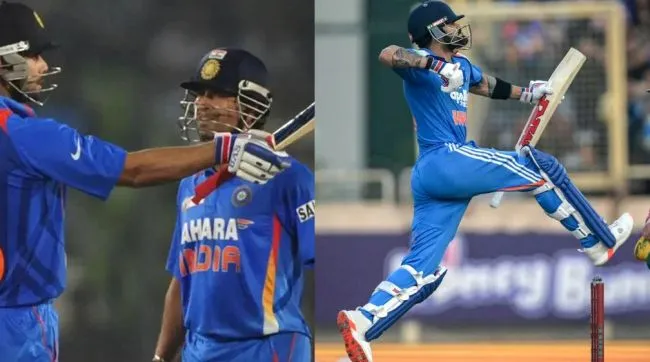
He revolutionized the fitness culture of the Indian platoon. Under his captaincy, the standard for fitness came a universal creed. Fielding, once a relative weakness, came a armament. Running between lattices came a intimidating form of aggression.
Kohli’s own potbellied constitution was a billboard for this new doctrine.
He sermonized that ultramodern justice was won not just in the mind or with the hands, but in the spa and on the track. He erected a pantheon of pugilists, where athleticism was a form of intimidation. This was a stark departure from the history and appealed directly to a immature, fitness-conscious nation.
He was the archetype of the ultramodern athlete- Cricket god, whose power was visibly manifested in his constitution and abidance.
Readmore When Titans Converge: The Billion-Rupee Battle
Pillar III The Forging of a Warrior- King Persona
Sachin was the cherished son. Kohli purposely drafted himself into the legionnaire- king. His captaincy, especially in Test justice, was aggressive, politic, Cricket and unapologetically concentrated on taking 20 lattices to win. He led from the front, amassing Test centuries at a pace that battled Sachin’s, but with the added burden of leadership.
He cultivated an image of visceral intensity.
The casket- thumps, the curse- laden fests, the fierce gapes — this was n’t the detached grace of a god, but the engaged fury of a monarch leading his Cricket colors into battle.
He erected a pantheon where passion was n’t just allowed but was the central ritual. For a generation that valued raw emotion and suggestive identity, Cricket Kohli’s visible fire was more relatable than serene detachment. He was a god you could grandly- five, not just supplicate to.
The Shadow as a Crucible, Not a pen
Crucially, Kohli noway disrespected Tendulkar’s shadow; he used it as a gauntlet to temper his own sword. He frequently spoke of Sachin with deep reverence, admitting the path he paved. But within that shadow, he set up the space to be different. He understood that the only way to escape the comparison was to change the parameters of the comparison itself.
He did n’t try to out- God the God. rather, he erected resemblant pantheons
Tendulkar was the dateless classic; Cricket Kohli came the grim hitmaker. Tendulkar soothed with thickness; Kohli thrilled with daring. Tendulkar bore the weight of anticipation with silent grace; Kohli shouldered it with a combative roar.
