

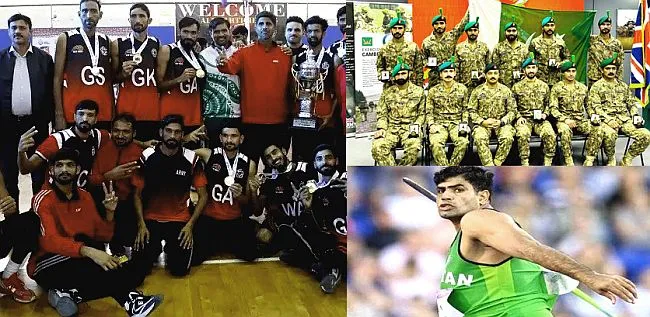
The ending form of Pakistan’s National Games is traditionally.
A festivity of the nation’s athletic spirit, a mosaic of colors representing businesses, departments, and services. Yet, at the recent edition, the tribune’s palette was overwhelmingly dominated by a single, commanding hue the gold of the Pakistan Army. The statistics were n’t just emotional; they were historically absolute.
The Army contingent did n’t just win; they finagled a total- system subjection, amassing a stunning 113 gold orders — a haul so vast it readdressed the scale of domestic sporting dominance. This was n’t a palm; it was a strategic exercise executed with military perfection, a demonstration of institutional power that swamped the games and left every other contender navigating the fate.
This inviting performance, while a testament to the athletes.
Fidelity, demands a forensic examination beyond the radiance of the tribune. How does one institution achieve similar inviting supremacy? The answer lies not in chance, but in a deep,multi-layered engineering of mortal eventuality and systemic advantage — a design for success that contemporaneously highlights critical crevices in Pakistan’s broader sporting ecosystem.
The design Pillars of the Golden Engine
The Army’s order machine is erected on foundational pillars that mercenary and parochial setups struggle to replicate, creating a competitive geography that’s unnaturally uneven.
1. The Career- for- order Covenant Ultimate Athlete Security
For a youthful athlete in Pakistan, the topmost adversary is frequently not a rival on the track, but query off it. The Army offers a important, nation-unique result a guaranteed career. Talented rookies are enrolled as dogfaces or officers, bestowed with a stable payment, lifelong medical care, casing, pension benefits, and the inflexible prestige of military service. This transforms calisthenics from a high- threat passion into a secured profession.
An athlete can train with total focus, free from the empirical anxieties of backing, outfit, or life after competition. This security is the Army’s most potent recruiting tool and retention strategy, creating a class of “ athlete- dogfaces ” whose sole charge is to exceed in their sport.
2. structure as a Force Multiplier
While mercenary athletes frequently train in dilapidated installations with intermittent access, the Army maintains a resemblant macrocosm of sporting excellence. Its cantonments house Olympic-standard swimming pools, synthetic athletic tracks, ultramodern gyms, and specialized courts that compete and frequently surpass — the stylish public installations in the country.
This structure is n’t an add- on; it’s integrated into the fabric of military life, icing time- round, disencumbered access. This constant, high- quality training terrain accelerates athletic development and provides a monumental advantage over challengers who must negotiate for time on crummy public grounds.
3. The Science of Regimented Excellence
The service’s core morality — discipline, scale, and methodical planning is impeccably transposed onto sports. Training is n’t ad- hoc; it’s a regimented crusade. Schedules are strict, diets are covered, and progress is tracked with a command- position focus.
The Army invests in elite coaching, frequently retaining public and transnational experts, and is decreasingly incorporating sports wisdom, activity, and psychology. This transforms raw gift into finely tuned performance machines. The “ charge ideal ” is clear palm gold. Every resource is marshaled toward that singular thing.
Readmore A New Dynasty Rises in Ashes’ Embers: Australia’s Demolition
4. The Ecosystem ofInter-Service Competition
Before indeed reaching the National Games, Army athletes are battle- hardened in a robust internal competitive circuit. Regularinter-unit,inter-corps, andinter-services crowns produce a nonstop pressure- cooker terrain. This constant internal competition ensures that only the absolute peak players are named for the public team, creating a platoon that’s formerly oriented to high- stakes contest.
The Domino Effect How Golden types More Golden
This system creates a tone- immortalizing cycle of dominance. Success at the National Games validates the system, attracting the coming generation of the country’s top athletic gift. A parent, seeing the security and success of Army athletes, is far more likely to Gold steer a blessed child toward a military trials camp than toward an underfunded parochial academe.
This nonstop gift siphon further deepens the resource and skill gap, making the Army’s dominance at the coming Games indeed more likely — a righteous cycle for the institution, but a potentially vicious bone for public sports diversity.
The Shadow on the tribune Critical Counteraccusations of a One- System Dominance
While the Army’s feat is a monumental organizational achievement, its scale casts a long and complex shadow over the health of Gold Pakistani sport as a whole.
1. The Civilians in the Shadow .
The most burning question is What happens to purely mercenary, fiefdom- grounded athletic development? When the tribune is constantly enthralled by athletes in institutional uniforms, it can demoralize parochial setups and obscure critical failures Gold in the grassroots sports channel managed by the Pakistan Sports Board. The National Games threat getting a predictable exhibition of institutional might rather than a true, competitive measure of civil sporting health.
2. The Resource Canyon and Competitive Imbalance .
The playing field is n’t position. Provincial sports departments operate with stingy, politically unpredictable budgets, outdated installations, and regulatory indolence. They’re contending not just against athletes, but against an entire state- within-a-state sporting outfit. This” resource flume” makes a genuine contest for the top spot nearly insolvable, challenging the core premise of a fair public crown.
3. The Narrowing of the Talent.
PipelineOver-reliance on institutional models can inadvertently constrict the public gift pool. bents who, for particular, academic, or ideological reasons, Gold do n’t wish to join the service or other uniformed services, may find their pathways to elite training and competition oppressively limited. A nation’s sporting eventuality should n’t be contingent on registration in a particular institution.
Readmore The Algorithm’s Bride: Sam Levinson Promises a Wedding
A Strategic Crossroads design or Warning?
The Army’s 113- gold subjection presents Pakistan with two starkly different narratives for its sporting future.
- Narrative A The National Blueprint. The Army’s model could be seen as the ultimate playbook. The challenge for the mercenary government is to acclimatize its core principles structured athlete weal, sustained investment in structure, and long- term methodical planning — into the public sector.
This would bear a revolutionary, bipartisan commitment to sports, treating athletes as public means and erecting parochial high- performance centers that can act as believable cancelers .
